Dividing the planet by eight billion: what one equal share actually comes to
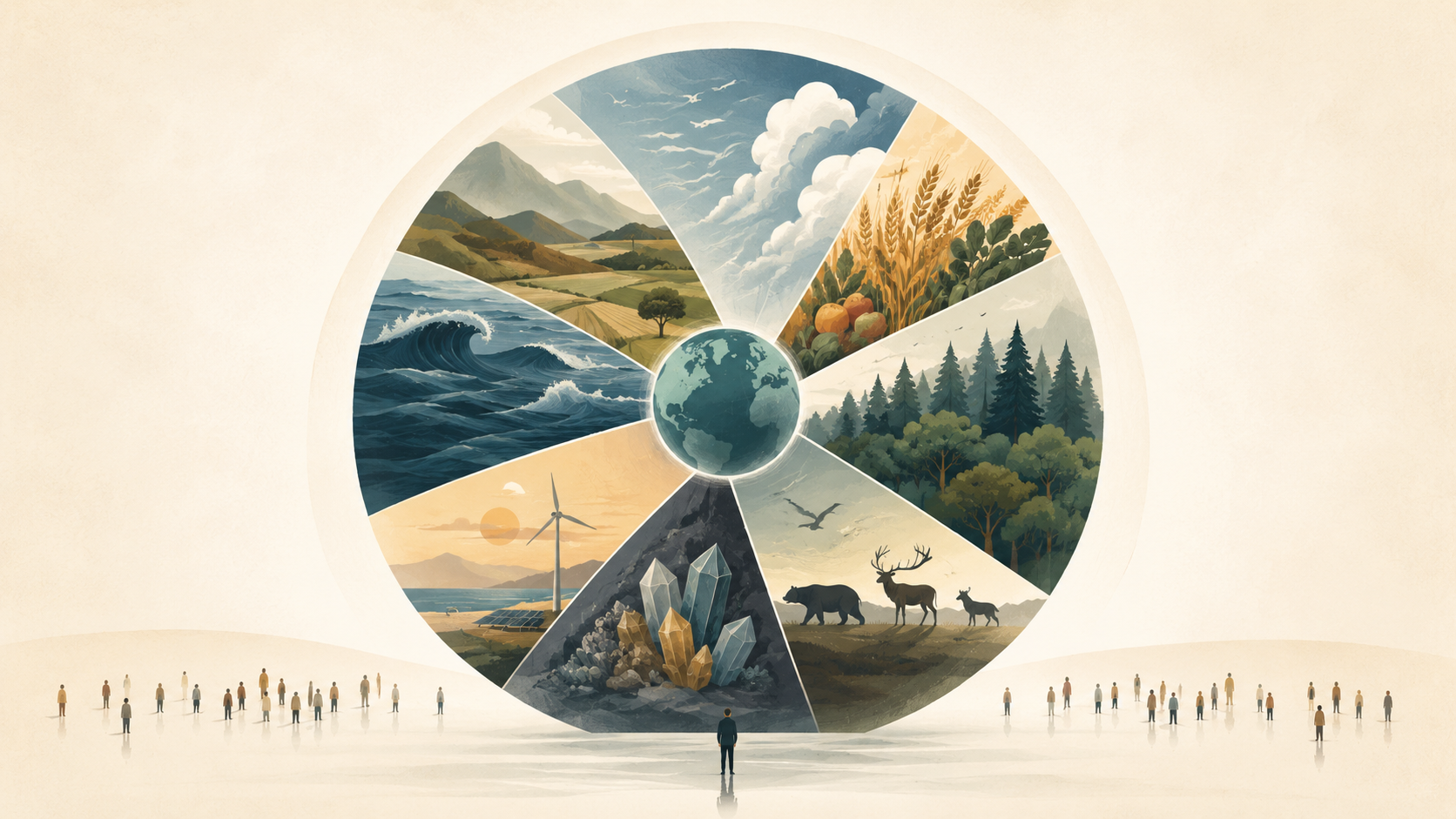
Earth's population passed eight billion in late 2022 and stands near 8.3 billion in mid-2026. Here is one arithmetic question, carried through to the decimal: take the planet's measured resources, divide each by every person alive, and read off what a single equal share comes to, in animals, air, water, food, plants, minerals, land, energy, and money. The division is a lens for the per-person endowment that markets rarely price. It is not a proposal to carve up the Earth, and most of what it counts cannot be moved or split.
What this exercise is
The operation is one step repeated. A measured global total, drawn from a statistical agency or a peer-reviewed census, divided by the world population. Every figure below was produced that way, checked against a second independent source where one exists, and recomputed by a separate pass before it was written down.
Two kinds of share appear, and the difference between them matters. A standing share is one person's slice of the planet as it exists right now: total mineral reserves, all the living cattle, the whole volume of fresh water, the standing forest. An annual share is one person's portion of what the planet produces and renews in a year: the harvest, the river runoff that refills, this year's mined copper, this year's economic output. For copper, the standing share of reserves is about 118 kilograms; the annual share of what is mined is about 2.8 kilograms. They answer different questions, so both are reported where both exist.
Five cautions hold for the whole exercise. Reserves are the economically recoverable subset of what is in the ground; the total physical stock is several times larger for most minerals. The shares are notional because resources are not fungible or movable: a per-person slice of Antarctic ice or deep-crust copper is a figure on paper that no one could collect. A standing stock is not consumed; a person lives on its annual yield, so the stock and flow figures describe different relationships to the same resource. And a global average divided evenly erases concentration: phosphate reserves come to 8.8 tonnes per person on paper while about 70 percent of them sit under one country. And the annual flows are production or use totals divided by population, so the energy, cereal, and water shares include what industry, agriculture, and freight consume on each person's behalf, beyond direct personal use.
The denominator
Every figure in this essay is divided by the same number: 8.3 billion people. The US Census Bureau's International Data Base projects 8,300,678,395 people for July 1, 2026. The United Nations World Population Prospects 2024, medium variant, gives approximately 8.30 billion for mid-2026 from a 2025 base of 8,191,988,453 growing near 0.84 percent a year. The two agencies agree to within a fraction of a percent, and this exercise uses 8.3 billion throughout.
One equal share, at a glance
Every value is one person's portion at a world population of 8.3 billion. Stock is the standing share; flow is the annual share. Sources and derivations follow in the sections below.
| Resource | Standing share (stock) | Annual share (flow) | Source |
|---|---|---|---|
| Land | |||
| Total land | 1.56 ha (15,640 m²) | FAO | |
| Habitable land | 1.25 ha (12,530 m²) | OWID | |
| Cropland | 0.19 ha (1,895 m²) | FAO | |
| Grazing land | 0.39 ha (3,865 m²) | FAO | |
| Air | |||
| Atmosphere | 620,000 t | Trenberth & Smith | |
| Atmospheric oxygen | 143,000 t | Trenberth & Smith | |
| Oxygen released by photosynthesis | 16,900 kg/yr | Johnson 2016 | |
| Water | |||
| All water | 167 billion L | USGS | |
| Fresh water | 4.2 billion L | FAO | |
| Surface fresh water (lakes, rivers) | 11.2 million L | USGS | |
| Renewable fresh water | 5.27 million L/yr | FAO | |
| Food | |||
| Cereals | 377 kg/yr | FAO | |
| Meat | 45 kg/yr | FAO | |
| Fish and seafood (live weight) | 22 kg/yr | FAO SOFIA | |
| Dietary energy supply | 3,016 kcal/day | FAO | |
| Animals | |||
| Cattle | 0.19 (1 per 5.3 people) | FAO | |
| Sheep, goats, pigs | 0.16 / 0.14 / 0.12 | FAO | |
| Chickens | 3.3 | FAO | |
| Wild land-mammal biomass | 2.4 kg | Greenspoon | |
| All wild-fish biomass | 84 kg carbon | Bar-On | |
| Plants and forests | |||
| Forest | 0.49 ha (4,892 m²) | FAO FRA | |
| Trees | 366 | Crowther | |
| Plant biomass | 54 t carbon | Bar-On | |
| Plant growth (net primary production) | 6.8 t carbon/yr | Field 1998 | |
| Minerals (reserves / annual production) | |||
| Iron ore (usable ore) | 24 t | 313 kg/yr | USGS |
| Copper | 118 kg | 2.8 kg/yr | USGS |
| Bauxite | 3.5 t | 53 kg/yr | USGS |
| Lithium | 4.5 kg | 35 g/yr | USGS |
| Gold | 8.0 g | 0.40 g/yr | USGS |
| Phosphate rock | 8.8 t | 30 kg/yr | USGS |
| Energy | |||
| Coal reserves | 129 t | EI / BP | |
| Oil reserves | 209 bbl (33,200 L) | EI / BP | |
| Natural gas reserves | 22,660 m³ | EI / BP | |
| Primary energy use | 71 GJ/yr | EI 2025 | |
| Solar energy reaching Earth | 660,000 GJ/yr | Penn State | |
| Economic equivalent | |||
| Annual income share (GDP) | $15,180/yr | IMF | |
| Household wealth share | $56,747 | UBS | |
| Comprehensive wealth share | ~$185,500 | World Bank | |
| Ecosystem services (2007 USD) | ~$15,060/yr | Costanza | |
Land
one person's standing share of land
The planet carries 12,981 million hectares of land by the FAO's 2022 accounting (agricultural 4,781, forest 4,050, other 4,150), which Our World in Data rounds to 13 billion hectares. Divided by 8.3 billion, that is 1.56 hectares each, or 15,640 square metres. Strip out glaciers, bare rock, and desert and the habitable share is about 1.25 hectares, 12,530 square metres.
The part that grows food is far smaller. World cropland is 1,573 million hectares, which is 0.19 hectares per person, 1,895 square metres. Grazing land of 3,208 million hectares adds 0.39 hectares each.
Air
one person's standing share of the atmosphere
The atmosphere weighs 5.148 x 10¹⁸ kilograms in the measurement by Trenberth and Smith. Divided by 8.3 billion, one share is 6.2 x 10⁸ kilograms, about 620,000 tonnes of air. Molecular oxygen is about 23 percent of that mass by composition, so the oxygen alone comes to roughly 143,000 tonnes per person, a figure derived from the atmospheric mass rather than measured directly.
Against that standing stock, the annual flow is small and constant. Global photosynthesis adds about 140 billion tonnes of oxygen to the atmosphere each year, which is 16,900 kilograms per person. A person breathes about 307 kilograms of oxygen in a year at the NASA metabolic rate of 0.84 kilograms a day. One person's annual share of the oxygen that plants release is roughly 55 times what that person breathes.
Water
one person's annual share of renewable fresh water
Earth holds 1,386 million cubic kilometres of water by the USGS figure, corroborated by the FAO. At 1012 litres to the cubic kilometre and 8.3 billion people, the standing share is about 167 billion litres each. Almost all of it is salt water and ice. Fresh water is 35 million cubic kilometres, 2.5 percent of the total, which is 4.2 billion litres per person, and most of that is locked in glaciers and deep groundwater. The fresh water sitting in lakes and rivers is 93,120 cubic kilometres, an accessible standing share of 11.2 million litres each.
What refills every year is the flow that matters. The planet's renewable fresh water is about 43,750 cubic kilometres a year in the FAO long-term balance, which is 5.27 million litres per person per year, about 5,271 cubic metres. A standing share of fresh water measured in billions of litres reduces, once only the renewable part is counted, to a few million litres a year.
Food
one person's annual share of cereals
Food is an annual flow. The world grew 3,133 million tonnes of cereals in 2024 by the FAO count, mirrored in the FAOSTAT series, which is 377 kilograms per person. It produced 374 million tonnes of meat, 45 kilograms each on a carcass-weight basis, and 185.4 million tonnes of fish and aquatic animals, 22 kilograms each at live weight, of which edible supply after processing is roughly half.
The supply side already divides itself. The FAO reports global dietary energy supply at 3,016 kilocalories per person per day for 2023, the first year it crossed 3,000. That number is per person by construction, an apparent supply at the retail level, so it overstates intake by the amount of food wasted after retail.
Animals
one person's standing share of live chickens
The world's livestock divides into small per-person counts. There are 1.58 billion cattle on the FAOSTAT count, 0.19 per person, about one head for every 5.3 people. Sheep number 1.36 billion (0.16 each), goats 1.19 billion (0.14), and pigs 0.96 billion (0.12). Chickens are the exception: 27.7 billion live birds, 3.3 per person.
Wild animals weigh very little by comparison. The total mass of wild land mammals is about 20 million tonnes in the Greenspoon census, which is 2.4 kilograms per person, on a single peer-reviewed estimate with a wide confidence range of 13 to 38 million tonnes. All wild fish together hold about 0.7 gigatonnes of carbon in the Bar-On biomass census, 84 kilograms of carbon per person, roughly 840 kilograms at wet weight, a figure the authors mark as order-of-magnitude. By living mass the gap is wider still: the same census finds about 630 million tonnes of livestock against 20 million tonnes of wild land mammals, roughly 30 times as much.
Plants and forests
one person's standing share of the world's trees
The world holds 3.04 trillion trees in the Crowther mapping, built from more than 400,000 ground measurements and confirmed by Yale. Divided by 8.3 billion, that is 366 trees each; the same count came to 422 per person at the 7.2 billion population of 2015, so the per-person share fell with the larger denominator while the standing stock held. The world's 4.06 billion hectares of forest give 0.49 hectares per person, 4,892 square metres.
Living plants are the largest store of biomass on the planet. Plants hold about 450 gigatonnes of carbon in the Bar-On census, independently corroborated near 450 by a separate inventory-based account, which is 54 tonnes of carbon per person. The land grows back 56.4 gigatonnes of carbon a year in net primary production by the Field estimate, confirmed by BioNumbers, an annual share of 6.8 tonnes of carbon per person.
Minerals and energy
one person's standing share of coal reserves
Mineral reserves are the economically recoverable stock, reported here from the USGS Mineral Commodity Summaries 2026. Iron ore reserves are 200 billion tonnes of usable ore, holding about 87 billion tonnes of iron, which is 24 tonnes of ore per person (about 10.5 tonnes of contained iron). Copper reserves of 980 million tonnes give 118 kilograms each, bauxite reserves of 29 billion tonnes give 3.5 tonnes, lithium reserves of 37 million tonnes give 4.5 kilograms, gold reserves of 66,000 tonnes give 8.0 grams, and phosphate-rock reserves of 73 billion tonnes give 8.8 tonnes each.
The annual mining flow is much smaller than the reserve. The world mines 2.6 billion tonnes of iron ore a year (313 kilograms per person), 23 million tonnes of copper (2.8 kilograms), 250 million tonnes of phosphate rock (30 kilograms), 3,300 tonnes of gold (0.40 grams), and 290,000 tonnes of lithium (35 grams). For most of these metals the in-ground resource is several times the reserve, so the per-person reserve understates physical abundance.
Fossil-energy reserves are a large standing stock measured at end of 2020, the last year the Energy Institute and BP statistical review updated the table. Coal reserves of 1.07 trillion tonnes give 129 tonnes per person, oil reserves of 1.73 trillion barrels give 209 barrels (about 33,200 litres), and gas reserves of 188 trillion cubic metres give 22,660 cubic metres each. The oil figure sits at the high end of published estimates because the series includes oil sands and natural-gas liquids; OPEC's crude-only proved reserves of about 1.57 trillion barrels would give 189 barrels per person.
Against those stocks, annual energy is a flow. The world used 592 exajoules of primary energy in 2024 in the Energy Institute review, an all-time high, which is 71 gigajoules per person per year. The sun delivers far more: about 174 petawatts of solar power reach the top of the atmosphere, confirmed by UCAR, which over a year is roughly 5.48 million exajoules, or 660,000 gigajoules per person. That 660,000 gigajoules is the raw flux reaching the planet, almost none of which is captured; it is about 9,000 times the 71 gigajoules of energy used per person each year.
The economic equivalent
There is no single dollar figure for one person's share, because the candidate totals measure different things. Four are worth stating, each with the question it answers.
The annual income share is world output divided by population. The IMF projects world GDP near 126 trillion US dollars in 2026 at current prices, which is 15,180 dollars per person per year. This is the flow markets actually count, the value added in a year.
The household wealth share is the stock of private assets. The UBS Global Wealth Report 2025 puts total net private wealth at about 471 trillion dollars at the end of 2024, covering markets that hold more than 92 percent of world wealth, which is 56,747 dollars per person. UBS divides this across adults rather than all people, so a true per-adult figure is higher.
The comprehensive wealth share adds what private balance sheets leave out. The World Bank's Changing Wealth of Nations 2024 measures produced, natural, and human capital together, with human capital at 60 percent of the global total in 2020. The database-derived global aggregate is roughly 1,540 trillion dollars, about 185,500 dollars per person; the World Bank publishes this as per-capita and income-group shares rather than a single headline total, so the aggregate rests on one source.
The ecosystem-services share prices the work nature does for free. Costanza and colleagues estimate global ecosystem services at 125 trillion dollars a year in 2007 dollars, which is 15,060 dollars per person per year. The authors stress that these are virtual non-market prices derived by benefit transfer, and that the total cannot validly be summed with or compared against GDP.
The relational-value reading
The four economic figures split by how often a market touches them. The flow that markets price continuously is world output, which divides to 15,180 dollars per person a year. The other three are valued intermittently or not at all: household wealth divides to 56,747 dollars, the World Bank's comprehensive wealth that adds natural and human capital to about 185,500, and the ecosystem services that no invoice records to about 15,060 dollars a year. The continuously priced flow is about a quarter of the household-wealth share beside it and under a tenth of the comprehensive-wealth share.
The Transmutarianism framework the Foundation publishes measures a quantity none of these capture: the relational value a person creates, the deprivation they absorb and the fulfillment they emit across a population. The equal-share figures in this essay describe an endowment before any person has acted on it. The distance between that equal share and what any individual actually holds is the distribution the Foundation's studies of populations excluded from how AI is built document, and the gap the wisdom economy is built to measure.
A note on framing
An equal share is a thought experiment carried to the decimal. Run it and the planet resolves into modest numbers: a hectare and a half of land, a fifth of a hectare that grows food, 366 trees, a fifth of a cow, three chickens, a few million litres of water that refill each year, a hundred-odd tonnes of coal in the ground, fifteen thousand dollars of output a year. The standing endowment is large and the annual flow a person can actually live on is small.
None of these shares can be collected, and the essay proposes no carving; what it offers is a denominator applied evenly to every figure. What the arithmetic does not show is how unevenly the actual holdings sit against the equal line, which is the measurement the Foundation builds toward. The math behind the framework is at transmutarianism.org/framework/. To dispute any number above, substitute a different total with a source, and the share moves.