Most of Canada and BC's $5-billion infrastructure deal is money already committed
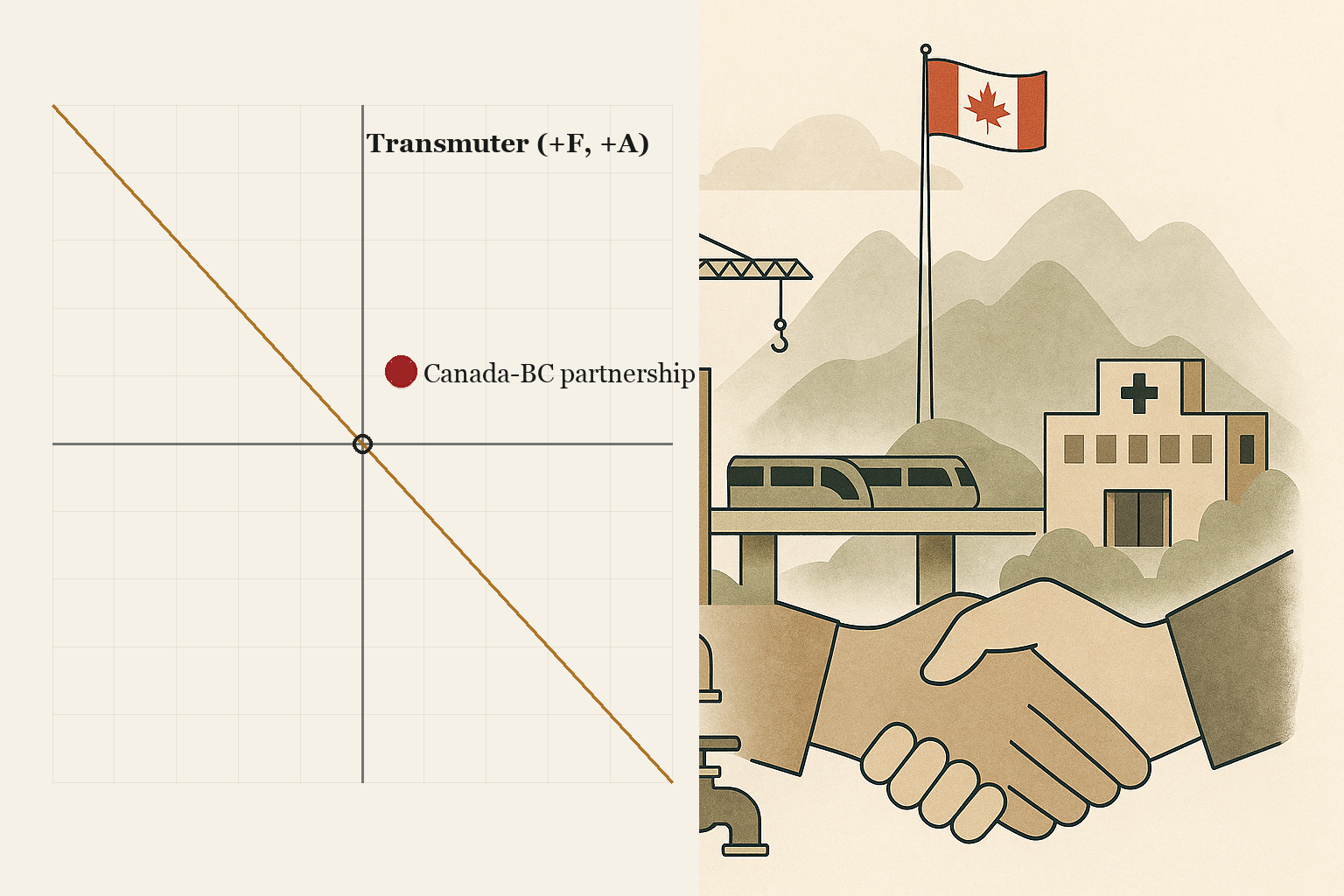
On June 18, 2026, the federal and British Columbia governments announced a partnership the Prime Minister's release frames as "more than $5 billion" for BC local infrastructure over ten years, delivered through the federal Build Communities Strong Fund. This field note measures what the partnership does to the flows of need passing through the province: the housing, health, and mobility deprivation it absorbs, and the fulfillment it emits back to the people it names.
What this evaluation is
The Foundation publishes a measurement framework called Transmutarianism. The framework scores any agent (a person, an organization, an institution, a government program) on what it does to the flows of need passing through it: deprivation absorbed without being passed on, fulfillment emitted in excess of what was received. The output is a position on a four-quadrant map (Transmuter, Absorber, Magnifier, Extractor) and a single weighted number, M, that captures the net relational work the agent does.
This post applies the framework to the Canada-British Columbia infrastructure partnership: a public-spending program, scored on its marginal contribution to BC residents across the Maslow hierarchy of needs. The math is at transmutarianism.org/framework/; the live quadrant explorer is at transmutarianism.org/quadrant/. Every empirical claim below links to its primary source. The scoring is transparent and partly normative; reasonable people may weight the levels and choose the counted population differently, and the point is to make the trade-offs visible and measurable rather than to deliver a verdict. The placement is provisional; better data moves the dot. The Foundation offers to run an audited version with any party that supplies the data.
Headline finding
Provisional placement: Transmuter, modest magnitude. Weighted moral work at τ=1: W = +36. Aggregate quadrant coordinates: F = +21, A = +13.
The partnership directs resources at lower-Maslow deprivation: health capital for a hospital system running above capacity, water and wastewater infrastructure, 700 supportive and transitional homes already delivered under a February 2026 agreement, and a new school and health centre for Tumbler Ridge. The framework reads delivered shelter, health, and mobility as positive filtering, and the transit and education components add modest amplification. The magnitude is small because much of the "more than $5 billion" itemizes money already committed under the Build Communities Strong Fund and the 2021 SkyTrain agreement, and the two flagship housing levers (a development-charge reduction and a 2,200-unit condo conversion) carry weak or contested benefit to residents.
The placement is sensitive to two choices the note states openly. Scoring the diverted public money as a negative lower-Maslow flow (the reannouncement, the condo bailout, the concurrent provincial pause on non-profit housing) moves the dot into the Magnifier quadrant. Applying the power handicap that the framework reserves for the most powerful agents (the federal and provincial governments together control housing, funding, health, and transit) moves the dot into the Absorber region against the raised bar, where it filters lower-Maslow deprivation but emits net-negative fulfillment, and at a larger handicap into Extractor. The funding itself is "subject to Treasury Board approvals" and "pending bilateral funding agreement," and the condo-conversion terms (price, affordability definition, financing) were deferred to fall 2026.
The partnership at a glance
| Announced | June 18, 2026, Vancouver, by PM Mark Carney and Premier David Eby (pm.gc.ca). |
|---|---|
| Vehicle | Federal Build Communities Strong Fund, a $51-billion, 10-year program announced in Budget 2025 (November 5, 2025) and enabled by Bill C-15, which received Royal Assent March 26, 2026. The fund's Community stream continues the former Canada Community-Building Fund (the renamed Gas Tax Fund). |
| Headline figure | "More than $5 billion" federal over 10 years for BC local infrastructure (pm.gc.ca). BC's entitlement under the fund's Provincial and Territorial stream is about $2.2 billion ($1.6B housing, $623M health) (Housing, Infrastructure and Communities Canada). |
| Development charges | Up to 50% reduction for multi-unit housing in priority communities, framed as up to $40,000 per unit; $1.6B federal matched 1:1 by BC for this and housing-enabling water, wastewater, and roads (pm.gc.ca). The federal $1.6B is BC's existing housing entitlement under the Provincial and Territorial stream. |
| Condo conversion | 2,200+ vacant condo units to be converted to affordable homes via Build Canada Homes and BC Housing using "innovative financing"; price, affordability definition, and financing structure deferred to fall 2026 (pm.gc.ca; The Hub). |
| One-time transfer | $284 million federal transfer to BC to reduce construction barriers, enabled through Bill C-15 (pm.gc.ca). |
| Health | $600M federal over 3 years, matched by BC ($1.2B total), for hospitals and emergency rooms (pm.gc.ca). |
| Transit | $2.5B over 10 years via the Canada Public Transit Fund, including the Surrey-Langley SkyTrain ($6B for 16 km, about $375M/km; project site), whose $1.3B federal contribution was committed in July 2021. |
| Coastal and regional | Up to $50M over 5 years for coastal community infrastructure, prioritizing Terrace and Prince Rupert; $200M ($100M each level) for a Tumbler Ridge secondary school and health centre, construction expected summer 2026 (CTV News). |
| Jobs and GDP claim | "42,000 jobs annually" and "$95 billion GDP over the decade" are figures for the entire national $51B fund rather than BC's share, and reflect modelled construction-phase activity (pm.gc.ca). |
| Conditionality | The release states the funding is "subject to Treasury Board approvals" and "pending bilateral funding agreement" (pm.gc.ca). |
Housing implications
The development-charge reduction is the housing measure the announcement leads with. CMHC's own analysis, published two weeks before the announcement, found that cutting development charges by 50 to 60 percent raises the share of viable housing projects by about 5 percent in Toronto and Vancouver, and that near-total elimination raises viability by 14 percent in Burnaby and as little as 3 percent in lower-charge cities (CMHC). CMHC's chief economist stated that reducing or even eliminating development charges "wouldn't solve the housing crisis" (BNN Bloomberg). Empirical work on development-charge incidence finds the charges fall on landowners through land prices rather than on buyers (University of Queensland), and Canadian housing-supply elasticity is low enough (about 0.63 percent in Vancouver) that cost reductions translate weakly into new units (Bank of Canada). The $40,000 figure is realistic at the bottom of the Canadian range and represents 8 to 16 percent of a new home's price in major markets (CMHC).
The 2,200-unit condo conversion is the partnership's most-debated element. Metro Vancouver held roughly 4,376 completed, unsold condo units in May 2026, so the target absorbs about half the standing overhang (Daily Hive). Independent analysts estimate purchase costs of $800,000 to $1.1 million per unit, putting the program near $1.76 to $2.5 billion before conversion expenses, with the affordability definition and financing undefined as of publication (The Hub). Against a BC need of roughly 450,000 homes by 2030, the conversion is under one percent of the gap, and it shifts existing market-rate units into public hands rather than adding net supply. The housing lever delivers real new affordable tenure at small scale and at high per-unit cost, and its supply effect on the broader market is modest.
Fiscal implications
The "more than $5 billion" headline conflates federal money with the provincial money that matches it, and new commitments with money already booked. The $1.6 billion for housing is BC's existing entitlement under the Build Communities Strong Fund's Provincial and Territorial stream, a fund announced in Budget 2025 and launched April 7, 2026, two months before this announcement; the housing and health figures are then doubled to $3.2 billion and $1.2 billion by adding the required provincial match (Housing, Infrastructure and Communities Canada). The $2.5 billion transit line runs through the separate Canada Public Transit Fund and includes the Surrey-Langley SkyTrain, whose $1.3 billion federal share was committed in 2021. A Conservative transport critic called the April fund launch "another reannouncement" of Budget 2025 money (CBC News).
The genuinely new content of the June 18 agreement is narrower than the headline: the bilateral development-charge mechanism, the condo-conversion partnership, the $200 million for Tumbler Ridge, and the $50 million coastal envelope. Federal infrastructure money also has a delivery record worth pricing in: the Parliamentary Budget Officer reported that only about 58 percent of the 2015 Investing in Canada plan had been disbursed, and found no consolidated federal tracking of infrastructure spending (PBO). The marginal new federal flow to BC residents attributable to this specific announcement is a fraction of $5 billion, and a ten-year, multi-administration timeline carries the slippage the framework treats as a discount on expected flows.
Labour implications
The "42,000 jobs annually" and "$95 billion GDP over the decade" figures in the release describe the entire national $51-billion fund rather than BC's roughly $5-billion share (pm.gc.ca). Standard infrastructure modelling puts job creation near 13,000 per $1 billion spent, so BC's annual allocation of roughly $500 million implies on the order of 6,500 jobs a year, well under the 42,000 in the headline (Economic Policy Institute). These are construction-phase positions, which the labour literature shows are concentrated in the build years and taper after completion; the framework scores construction employment as transient narrative rather than a steady-state amplification credit. The durable labour effect is the small number of permanent operating roles the new transit, health, and school assets require.
Urban and municipal implications
The development-charge reduction transfers a financing problem from developers to municipalities, and the federal money is the backfill. Metro Vancouver Regional District estimated a $389 million revenue shortfall from cutting its development cost charges under the agreement ($270.5M water, $75.5M sewerage, $43M parkland), and mayors said the program offers no new recurring municipal revenue and withheld the detail they need (Daily Hive; CBC News). The water and wastewater component is the partnership's most defensible supply lever: municipal sewer and water capacity is a documented binding constraint on new housing, and capital that lifts it enables development the cost cuts cannot. The transit component lands against flat demand, with Metro Vancouver transit ridership down 1.5 percent in 2025 and TransLink forecasting a further decline in 2026 (Daily Hive). The coastal $50 million targets real gaps, including Prince Rupert's recurring water advisories, though the city's mayor said he received no advance notice of the funding (CKPG Today).
Ethical implications
The partnership arrives as the province withdraws from non-profit housing. BC Budget 2026 paused the Community Housing Fund, which the Co-operative Housing Federation of BC said removes about 4,000 permanently affordable homes, and the BC Non-Profit Housing Association recorded the annual community-housing completion target falling from 4,500 to 2,500 units while calling public money for the condo market "a misuse of public funds" (CBC News; BCNPHA). The condo-conversion design carries a moral-hazard objection raised across the political spectrum, from the federal Conservative leader calling it a "bailout" to housing analysts describing perpetual subsidy of units bought near market price (CBC News; The Hub).
The accountability gap most relevant to the framework is who sat at the table. The Prime Minister's release names Tumbler Ridge, Terrace, and Prince Rupert but does not mention Indigenous peoples, consultation, or consent (pm.gc.ca). As of publication, no affected Nation had published a statement on the partnership: not West Moberly or Saulteau in the Treaty 8 territory around Tumbler Ridge, and not Lax Kw'alaams, Metlakatla, Kitselas, or Kitsumkalum on the coast. Separate Indigenous housing delivery proceeded on its own track, including 70 homes opened for Lax Kw'alaams members in Prince Rupert on June 5, 2026. The public record documents infrastructure directed to these communities without documenting their participation in its design; the actualization level in the scoring registers that gap at zero.
Where the partnership sits on the quadrant
The Transmutarianism framework scores agents on F (filtering of deprivation: deprivation absorbed without being passed on) and A (amplification of fulfillment: fulfillment emitted in excess of what was received). Moral work M = [τF + A] / √(τ²+1) (at the parity origin F₀ = A₀ = 0) is computed per Maslow level (physiological, safety, belonging, esteem, actualization) and weighted by w = {5, 4, 3, 2, 1}, so lower-level deprivation is heavier. The normalizer keeps M comparable across τ settings; a power coefficient ρ can raise the bar for powerful agents.
The chart below plots the partnership's provisional placement (sigil-red outline) against the four archetype reference dots (muted, shown for orientation). Drag the τ slider to test the flourishing-versus-cycle-breaking weighting, and the ρ slider to apply the power handicap. Click any dot for its F, A, and M values.
Assumptions, stated
- Scope of evaluation. The June 18, 2026 Canada-BC partnership as announced: the development-charge reduction, condo conversion, $284M transfer, health, transit, coastal, and Tumbler Ridge components, at steady state. Excluded: the broader national $51B Build Communities Strong Fund except where it sets BC's entitlement, and BC's separate provincial housing programs except where they offset the partnership (the Community Housing Fund pause is treated as context in scoring rather than as a separate scored flow).
- Time horizon. Steady-state at full delivery rather than the construction phase. Construction jobs and the modelled GDP multiplier are real but transient and are not scored against the steady-state dot.
- Asymmetry coefficient (τ). Default τ = 1. Sensitivity at τ = 0.8 (flourishing focus) and τ = 1.5 (cycle-breaking focus) is in the math box below.
- Maslow weighting. w = {5, 4, 3, 2, 1} for {physiological, safety, belonging, esteem, actualization}; lower-level deprivation is heavier.
- F and A scale. Each level scored on a −10 to +10 range, central estimate from the public-record evidence above. The reasoning column names the inputs.
- Denominator. The counted population is BC residents as recipients of the announced infrastructure (housing seekers, transit riders, patients, and the residents of the named communities), province-wide, chosen because the partnership is a province-wide public investment. Excluded: the general federal tax base that funds it, and out-of-province flows. The strongest alternative denominator a critic would choose is all BC taxpayers, which foregrounds the cost side; the alternatives table recomputes the dot under it.
- Treatment of diverted resource. Central treatment: the public money is excluded as a counterfactual and only emitted flows are scored, with the emitted flows discounted for reannouncement, conditionality, and capture. The negative is not booked at gross opportunity cost, because the partnership deploys public money toward public goods rather than consuming a public asset. The alternative treatment scores the diverted money as a negative lower-Maslow flow where it is reannounced, captured (the condo bailout, the development-charge windfall), or displacing (the concurrent non-profit-housing pause); the alternatives table shows where the dot lands under it.
- Power-asymmetry (ρ and ΔM). Central verdict at ρ = 1 (parity). The federal and provincial governments are the larger party in the audited flow and control the resources the denominator population needs (housing approvals, funding, health capacity, transit), so the operational power trigger holds; the ΔM band is reported below, in M-units on the weighted scale.
Per-Maslow scoring
The aggregate dot above is computed from the per-level table below. Each F and A value is the central estimate from the public-record evidence in the prior sections; substitute different numbers and the dot moves.
| Level (w) | F | A | Mₙ | w·Mₙ | Reasoning |
|---|---|---|---|---|---|
| Physiological (5) | +3 | +1 | 2.8 | 14.1 | Health capital, water and wastewater, supportive homes already delivered; discounted hard for reannouncement, weak development-charge efficacy, condo-conversion capture, and the concurrent non-profit-housing pause. |
| Safety (4) | +3 | +1 | 2.8 | 11.3 | Emergency-room and hospital capacity, housing stability, the Tumbler Ridge health centre; same delivery-risk and conditionality discount. |
| Belonging (3) | +1 | +2 | 2.1 | 6.4 | Transit access and coastal community infrastructure connect communities; transit is largely pre-committed and ridership is flat, so the filtering is small and the amplification carries the level. |
| Esteem (2) | +1 | +2 | 2.1 | 4.2 | A new Tumbler Ridge secondary school reduces educational deprivation and amplifies opportunity in one small community. |
| Actualization (1) | 0 | 0 | 0.0 | 0.0 | The partnership is delivered to communities without visible co-design: the release omits Indigenous peoples, no affected Nation has responded, and a named city's mayor had no advance notice. Scored at zero rather than negative. |
| Total W | 36.1 | Net moral work at τ=1, full delivery. |
Where the dot lands under the alternatives
These are the standing alternative constructions from the pre-publication assumption gate, recomputed on the same per-level basis.
| Construction | Fagg | Aagg | W (τ=1) | Quadrant |
|---|---|---|---|---|
| Central (diversion excluded, recipient denominator, ρ=1) | +21.3 | +12.7 | +36.1 | Transmuter |
| Diversion scored (reannouncement, condo bailout, non-profit pause booked negative) | −6.0 | +9.3 | +3.5 | Magnifier |
| Taxpayer denominator (funding base, cost side foregrounded) | +6.0 | +3.3 | +9.9 | Transmuter (near Conduit) |
| Power handicap ΔM = 1.79 (ρ raised for the governments; smallest archetype flip) | +21.3 | +12.7 | +9.2 | Absorber (read against the raised origin; Extractor beyond ΔM = 3.02) |
The placement swings to Magnifier on the diversion choice and, under the power handicap, leaves Transmuter for the Absorber region at ΔM = 1.79 and reaches Extractor beyond ΔM = 3.0, so the central dot is not presented as forced by the evidence. Several harsher score constructions surfaced by the pre-publication assumption gate (a marginal-new-only scope, stripping the pre-delivered supportive homes, a capped-and-netted diversion, lower base-level filtering, and scoring the co-design gap as negative voice) all keep the dot in Transmuter at smaller magnitude, with W between roughly +19 and +35. The verdict depends on a civic question the framework cannot settle: whether a government's deployment of partly-reannounced public money toward real but modest lower-Maslow goods counts as relational work above the baseline expected of the most powerful agents in the country, or as the passthrough that baseline already assumes. Substitute different F and A values per level, each with a source, and the Foundation will publish the re-audited placement.
Public-interest recommendations
The partnership's relational value rises or falls on disclosure and delivery, both of which are still pending.
For the Government of Canada
- Publish the federal-only figure separately from the matched provincial total, and state which components are new commitments versus BC's existing Build Communities Strong Fund entitlement and the 2021 SkyTrain money.
- Set and publish a units-delivered target for the condo conversion and the development-charge reduction, so the housing claim can be measured against an outcome rather than an input.
- Attach an affordability covenant with a stated duration and income threshold to every converted and enabled unit, and report disbursement against commitment annually given the 58-percent delivery record on the prior infrastructure plan.
For the Government of British Columbia
- Reconcile the partnership with the paused Community Housing Fund: state whether the converted condos add to or substitute for the lost non-profit units, and at what net change in deeply affordable supply.
- Publish the priority-community list and the per-municipality development-cost-charge backfill, so councils can confirm the federal money covers the revenue they are required to forgo.
For municipalities and the regional districts
- Tie any development-cost-charge reduction to a measured infrastructure-capacity plan, so the water, sewer, and road backfill reaches the projects the cuts are meant to unlock.
For the affected Nations and the partners
- Bring the Treaty 8 and coastal Nations into the design of the Tumbler Ridge and coastal projects as parties rather than as named beneficiaries, and publish the consultation record; this is the single change that most raises the actualization score.
- Disclose the condo-conversion procurement (a reverse auction, the purchase prices, the selection criteria) so the program can be told apart from a developer bailout.
The audit protocol (six inputs)
An audited placement requires six inputs. The Foundation offers framework, scoring template, methodological support, and the published report to any party willing to supply them.
- The signed bilateral funding agreement, with each line item marked new commitment or existing entitlement.
- The condo-conversion program terms: acquisition prices, the affordability definition and its duration, the financing structure, and the unit count by community.
- The development-charge reduction by priority community, with the matched municipal backfill and the projected net new units.
- Delivered community-benefit infrastructure measured at the point of delivery (supportive homes occupied, hospital beds added, transit boardings enabled, litres of water capacity).
- The consultation record with affected Nations and municipalities, including any co-design or benefit-sharing terms.
- Annual disbursement against commitment, so the steady-state dot can be re-scored as delivery lands.
Contact: sev@economyofwisdom.com.
What changes the placement
Toward Transmuter: the federal-only and net-new figures are published and a meaningful share is new money rather than reannouncement; the condo conversions carry a long affordability covenant and add to rather than replace non-profit supply; the affected Nations and municipalities become parties to the design; disbursement tracks commitment instead of slipping.
Toward Extractor: the $5-billion headline proves to be almost entirely reannouncement; the condo conversion buys units near market price with no enforceable affordability and clears developer balance sheets; the municipal backfill falls short and ratepayers absorb the gap; the development-charge savings capitalize into land values and never reach residents.
Better data moves the dot.
A note on framing
A government deploying public money toward housing, health, and transit is doing the kind of work the framework was built to credit, and this note credits it: the central placement is a Transmuter, because water capacity, hospital beds, supportive homes, and a school in a small town are deprivation absorbed and passed on as relief. The same instrument records why the credit is small: a headline that doubles federal dollars with provincial dollars and itemizes money announced in November as news in June measures announcements, and announcements are not flows. The framework scores flows.
The honest reading sits in the gap between the central dot and the alternatives. Score the reannouncement and the bailout as the diverted public money they involve, and the partnership reads as a Magnifier. Hold the governments to the higher bar the framework reserves for the powerful, and the modest delivery slips out of Transmuter: against that raised bar it filters more deprivation than it emits fulfillment, which is the Absorber's posture. The Foundation publishes the central placement and both alternatives so the parties at the table argue over the assumptions in the open, where they can be checked.
The math is at transmutarianism.org/framework/. The dot is plotted on the live quadrant explorer at transmutarianism.org/quadrant/. To dispute the placement, substitute different F and A values per level, with a source for each, and the dot moves.