Who Shapes Consciousness
On Identity, Environment, Power, and Agency
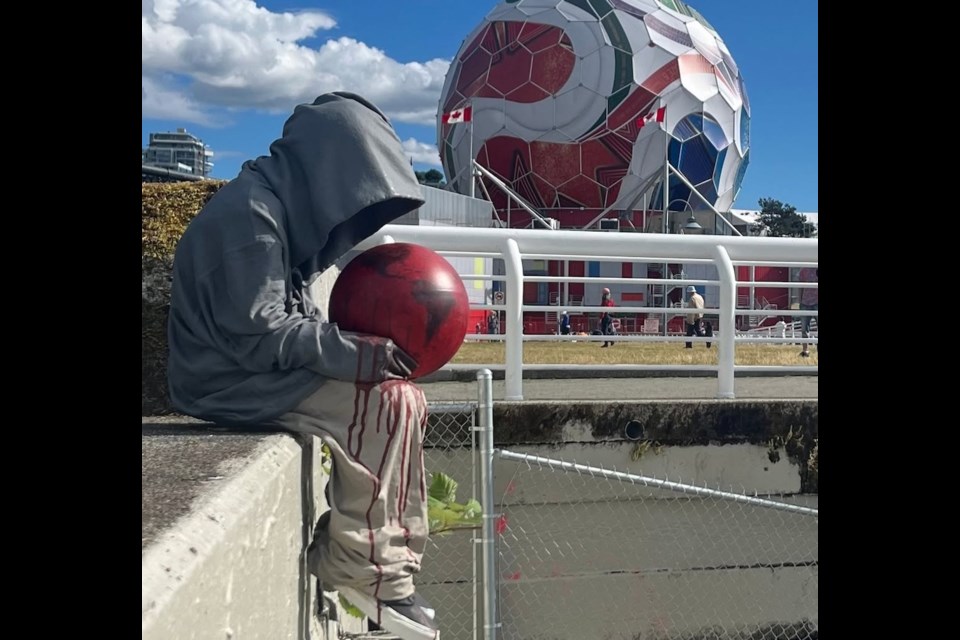
This month the city turned itself into a logo. Science World's geodesic dome became a giant replica of the tournament's match ball. A blue sculpture went up at Creekside Park with the tournament logo's trophy shape carved through its centre, set so the opening frames BC Place in the distance. Granville Street became a five-block branded playground. The waterfront walk from Science World to the stadium, the tournament's official last mile, was given over to FIFA. The environment was rewritten in a matter of weeks by a global brand and a host committee, and most people walking through it will absorb the new shape without ever registering that a choice was made on their behalf.
Then someone answered. A guerrilla artist who goes by Lupo installed a sculpture of a small boy on a wall above the water near Science World, on that same FIFA-draped stretch. The boy sits looking down at the world below him, inky red, blood running down his legs. No permit. No sanction. A second shape placed against the official one, offering a different reading of the same event. The commissioned installation was built to make you feel the spectacle. The smuggled one was built to make you feel its cost.
Two parties shaping the same environment, holding wildly unequal power to do it, and the shape each leaves behind decides what the people moving through will think and feel. Identity, environment, power, agency.
These four words are one structure seen from four angles. Identity is the shape consciousness takes. Environment is what does the shaping. Power is who holds the position from which the shaping flows. Agency is whether you can move that position back to yourself. Walk the line all the way through and you arrive at a single question. Who shapes consciousness, and why did we give so much of that power away.
Identity
Start with what the self actually is. We are world models, built over years out of the five senses mixed with internal emotional states, approximated in the neural network of the brain. There is a Big I, which is the universe, and a little i, the self-referential world model that the neural net constructs and then mistakes for a separate thing. The little i is the pattern that says "I did this, I want that." It is a representation. The little i cannot perceive the Big I directly, because it is the medium the little i arises in. Asking it to is like asking an eye to see itself seeing.
Ego-identity is therefore a construct, an illusion of a self standing apart from the universe. The neural net is already an approximation of the universe, and every adjustment to it, every act of learning, happens only in contact with the universe. A self sealed off from that has no way to have come into being. Identity is a process, inception to evolution, as part of the whole. It is a current you are.
I think aphantasia makes this easier to see. With no visual theater running, consciousness shows up as a constant information stream. There is no internal picture of the self to reify, no solid-seeming image of "me" sitting behind the eyes. The constructed nature of the little i stays transparent. Most people experience identity with imagery dense enough to feel like furniture. Without the pictures, the map never gets mistaken for the territory.
This matters because of how we hold our structures. Intelligence is a physical arrangement of information. Frameworks are intelligent structures too, at best approximations of an interpretation of truth. We carry frameworks in our heads, and they modulate the consciousness that flows through them. You cannot process raw reality without compression. But the relationship to the structure determines everything.
When the framework is your identity, the structure is you, and questioning it feels like death. The ego welds itself to the pattern and defends it. This is why arguing ethics with someone whose ego-identity is fused to their ethical framework is futile, and why people have always been willing to die for constructs they made in their own heads. When the framework is a tool, you have structures, you are not made of them. You pick one up, adopt it provisionally for a purpose, examine it, set it down. The crystallized intelligence serves the fluid consciousness.
The second mode means tolerating groundlessness. If no framework is absolute truth, you are always mid-air. Most people grab the nearest solid thing and hold. The developmental move is the willingness to let crystallized structures go fluid again, to melt them down, reexamine, reconfigure. Free your mind and the rest will follow.
Environment
Now the substrate. The structures around us are static. Buildings, logos, layouts, the engineered surfaces of a city hold still. On the other hand, the brain neurons are plastic. Their shape derives from the environment they sit in. So the static thing shapes the plastic thing, continuously, below awareness. Your environment, your city, shapes your consciousness. Someone who spends a life in a built grid grows a consciousness with a fundamentally different shape than someone who spends it in nature. It is the loop: space is produced, and the produced space then produces the people inside it.
If the environment shapes thought, then the question is who shapes the environment and therefore shapes our consciousness. And why did we hand so much of our conscious self-determination to a small set of planners, developers, and global brands. The structures that grow us were designed by interests that are not ours. The city is a substrate that shapes neural geometry, and the substrate has been captured.
That makes it a question of right. There is no clean codification for the right I am describing, the right to an environment not shaped by someone else's interests. It sits in the gap between three existing rights. The deepest match is freedom of thought, Article 18 of the Universal Declaration, the forum internum, the inner realm. It is the one right that is absolute and non-derogable, with no public-emergency exception, because the inside of a mind is supposed to be beyond reach. The 2021 Special Rapporteur report extended it to exactly this concern, the digital and cognitive technologies that subtly shape choices, preferences, and even thoughts, and it named a positive duty: that states foster an enabling environment for freedom of thought. That positive duty is the closest legal hook to what I mean. The synthesis itself, environmental cognitive sovereignty, the forum internum's enabling-environment duty applied to physical space, does not yet exist as a named right.
The lineage is older than the neuroscience. This is the right to the city. Space is produced, the production was captured by capital and planning, and the right at stake is the right to participate in producing the space that in turn produces you. The Situationists had the whole of it decades ago: the spectacle as capital colonizing consciousness through the engineered environment, psychogeography as the built form shaping the psyche, and the constructive program of reclaiming the construction of space to reclaim the self. A boy bleeding on a wall above a FIFA-painted waterfront is psychogeography with no theory attached. It is a citizen with no permit doing, at street scale, the exact thing the planners did with a budget. I am rediscovering their problem with better instruments and a rights framework they did not have. If we can prove that environment shapes thought, and we can, then Article 18 becomes operational, and it empowers all of us to start shaping our environment.
Power
So who gets to do the shaping. This is where the four words collapse into one.
Watch how the same technology gets framed. When the knowledge class talks about AI in relation to themselves, it is an empowering tool, a collaborator, an accelerator, an augmentation. When the same class talks about AI in relation to underprivileged populations, the language flips to extraction, surveillance, displacement, harm done to passive recipients. Nothing about the technology changed between those two sentences. What changed is the power position of the speaker. The knowledge class has agency over its relationship with AI and narrates itself as wielding it. The underprivileged get narrated as subjects AI is done to. I call this Transmutarian Interference. The interference lives in the discourse.
The discourse strips agency from one class before any tool enters the room. Why does the knowledge class get the privilege of using AI while the underprivileged get told it is being done to them. It is a perspective and it is a power relationship. Even out the perspective and a different picture appears, one where the displaced are agents with AI.
When a language model summarizes testimony that carries genuine distress, the moral signal gets attenuated on the way through. The deprivation in the raw account gets softened before it reaches the decision-maker. A policymaker reading a clean summary of hard conditions receives a sanitized version, and the information encoded in the rawness, which is the testimony of deprivation itself, is exactly what gets lost. The model does not just decline to repeat the harshness. It fails to carry the signal the harshness was made of. Attenuation flows preferentially against those without the power to set the terms.
In the formal language the asymmetry has a coefficient. Power raises the bar. An agent with power above parity does not get to claim moral credit on the same scale as a small actor doing the same good, and an agent with power who merely passes things through, who does nothing, scores below zero. Passthrough by the powerful is extraction, structurally. The neutral bar moves up with the power, and standing still beneath it is a debt.
And the language we use to hide all of this is the pronoun "we." "We" diffuses agency so thinly that no one is accountable. Meaningful agency over consequential outcomes sits with a small number of actual decision-makers. The broad population functions as ambient context, yet the pronoun lets that population claim credit for good outcomes and disclaim responsibility for harm. "We the people" and "we were just following orders" are the same mechanism running in opposite directions. The few who decide get cover. The many who did not participate get either an honor or an alibi. Thus, the pronoun becomes a moral laundering device.
Agency
Which returns it all to agency, because agency is the only exit.
Consciously, you construct realities by making choices. It is like a role playing game. You operate inside parameters you did not pick, genetics, culture, the city that grew you, and inside those you still make consequential choices. The scope of your agency determines how much of the world you can construct. Greater resources, position, and skill let you construct more of your own reality. Less of those, and the constructible region shrinks. Agency has a radius, and power sets the radius.
The same mechanism that captures the environment, that holds the high-power origin, that frames one class as wielders and another as subjects, is the mechanism that sets the radius of everyone's agency. The origin-holders shape the substrate, the substrate shapes consciousness, and the shaped consciousness has a smaller scope from which to push back. The loop closes on itself. Power shapes the environment, the environment shapes the self, the smaller self has less power. Left alone it compounds.
Breaking it is a question of returning the origin to the inhabitant. At the level of the self, that is holding frameworks as tools, keeping consciousness fluid, refusing to let any single structure crystallize into "me." At the level of the environment, it is the right to participate in producing the space that produces you, operationalized through freedom of thought. At the level of power, it is making the asymmetry visible and costly, measuring it directly, refusing the pronoun that launders it, and insisting that the displaced are agents with the tools. Forced attribution and forced anonymity are both agency-reducing. What matters every time is whether the person at the receiving end keeps the choice.
There is an internal version too, the smallest scope and the one always available. Acknowledge the feeling. Examine the thought, because "I am upset" is a feeling and "I am upset because nobody likes me" is a story bolted onto it, and the story can be checked. Then take responsibility for the action through deliberate choice. "I cannot do this because I am terrified" and "I am choosing not to do this because I am unwilling to risk the cost" describe the same action. The second one moves the locus of responsibility inside. That shift, from external to internal locus, is the seed of every larger reclamation. It is the same move at the scale of a single decision that the right to the city is at the scale of a civilization. Regain agency over yourself, your own consciousness, and you have the origin back.
So the four words resolve. Identity is a constructed current. Environment is the substrate that shapes the current, and it has been captured. Power is the position the capture flows from, and its signature is asymmetry, attenuation, and the laundering pronoun. Agency is the radius of what you can construct, set by power, and the work is to widen it, to move the origin back from the planners and the brands and the few who decide, to the inhabitant, to the self, to the people who were told it was being done to them. The whole project is one sentence. Take back the power to shape what shapes you.
The boy on the wall does not stop the tournament. The official logo still frames the stadium, the dome is still a soccer ball, the waterfront still belongs to the brand for the season. He is one small shape against an enormous one. He had the smallest possible scope of agency, a wall and no permit, and he used all of it to put a different reading of the world where the spectacle could not quite cover it. Everyone has a wall. The question is only whether you treat the shape you were handed as yours.
Credit. The "ghost child" sculpture is the work of the Vancouver guerrilla artist who goes by Lupo. It was photographed and reported by Elana Shepert for Vancouver Is Awesome.
Reference. Elana Shepert, "'Guerilla sculpture': Vancouver artist installs haunting ghost child during FIFA," Vancouver Is Awesome, June 13, 2026.